Propose
A model, planner, rule, or tool suggests an action. This is a belief or plan, not an authorization.
Output: a candidateEPV research artifact
Statistical Execution Authority for AI Agents
Capable systems can propose and rank actions. They still need evidence before they are allowed to act.
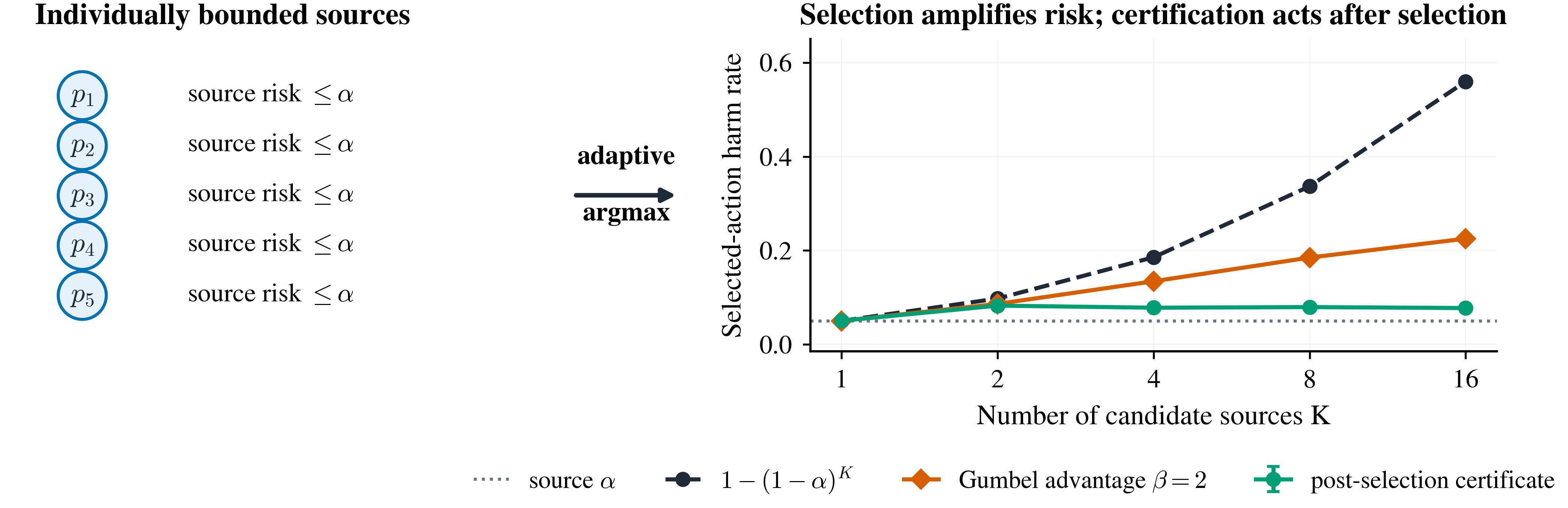
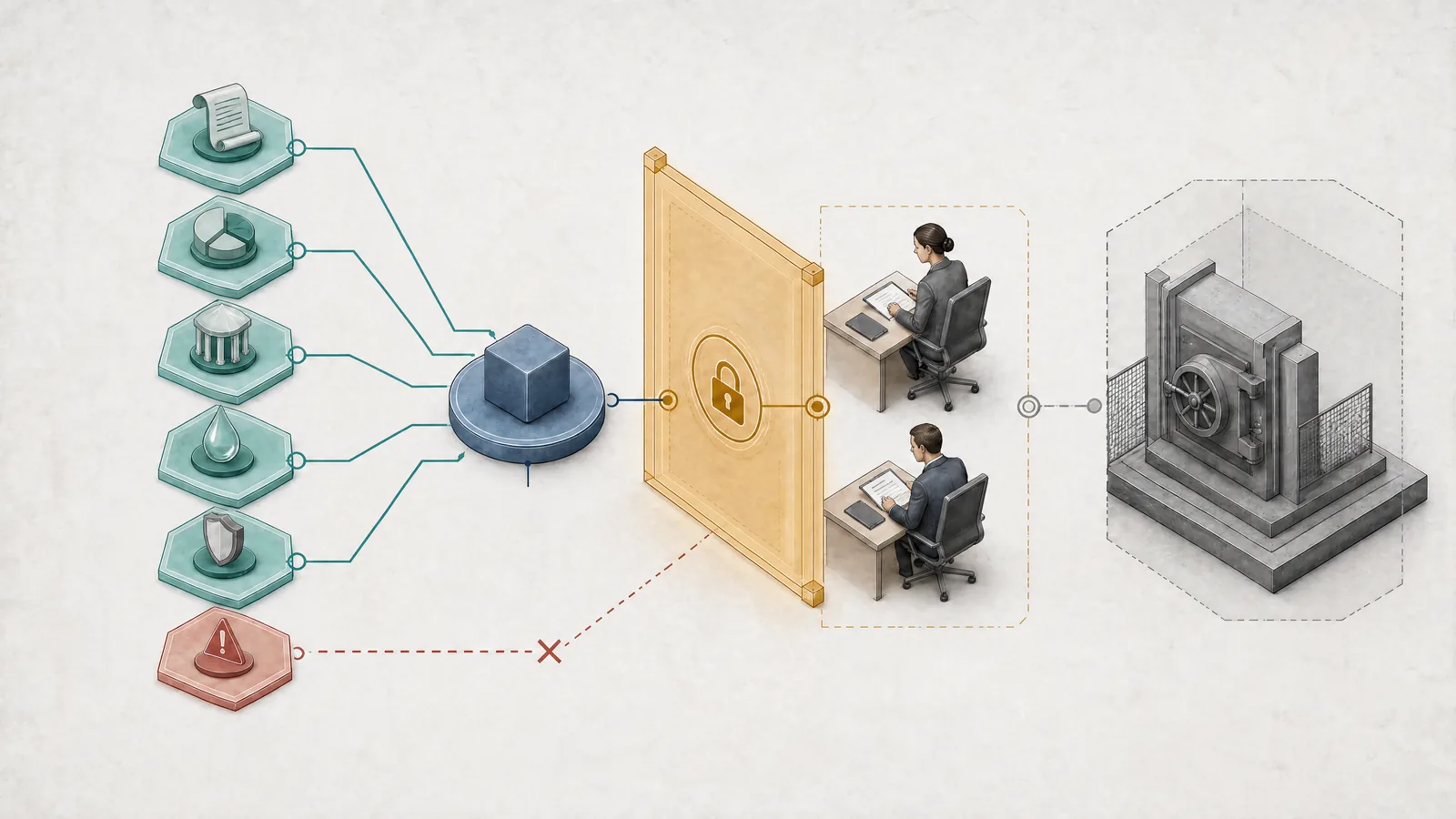
In a multi-candidate agent pipeline, a source-level safety signal need not survive eligibility checks, scoring, and adaptive selection. This paper certifies the selected action of a frozen pipeline, then routes it to authorize, review, or abstain under registered conditional-risk bounds.
In plain language: an agent may suggest a good action, and the system may choose its most convincing suggestion, but neither step alone proves that the final action should be executed.
Reviewer mode
EPV identifies selected-action authority risk as a post-selection object and introduces split-local EPV-Opt to certify and route the final selected action under pipeline-bound finite-sample risk bounds.
Registered claim
Candidate count alone does not determine whether the final selected winner becomes more or less adverse.
make sea-theory and make sea-v4-audit from the uploaded Code and Data Supplement.Interpretation boundary
This does not claim that adding candidates always increases risk. The independent heterogeneous identity and the dependence-free replacement decomposition have distinct assumptions.
Registered claim
The final selected action is the object tested by EPV-Opt; score clearance alone is not authorization.
fig:ps_epv, fig:sea_results, and tab:sea_v4.make sea-v4-audit, make sea-v4-tables, and make verify from the uploaded Code and Data Supplement.Interpretation boundary
Applies only to the frozen registered MiniWoB pipeline, task groups, adverse-action proxy, and IID split assumptions. It does not establish production harm prevention or universal agent safety.
Registered claim
An unregistered candidate, registry, score, threshold, tie-rule, task-family, or learned-state change fails closed until recalibration.
make verify from the uploaded Code and Data Supplement.Interpretation boundary
Versioning is an invalidation rule, not a drift-robust, online, or environment-independent certificate. AgentDojo V10 does not confirm transfer.
Suggested reviewer path
1. Reality: the problem
Imagine an assistant that can send an email, edit a document, call an API, or submit a form. It can produce a fluent plan and report high confidence. The practical question is not only whether the plan sounds reasonable. It is whether the exact action selected by the whole system should be allowed to change external state.
A multi-source system may receive proposals from a planner, a rule, a tool, a critic, or a cached rationale. A source can look safe in isolation, while selection favors a harmful or unsupported candidate. The paper therefore studies the final selected action, not the confidence of an individual source.
| Everyday situation | What can go wrong? | Paper's question |
|---|---|---|
| Many suggestions | The most confident suggestion may not be the safest. | What risk does selection create? |
| One winner | The system may choose a candidate before checking its consequences. | Which exact action won? |
| External action | A failed state change can cost time, data, or trust. | Does the winner earn authorization? |
2. Plain-language concept
The easiest way to read the paper is to keep these three verbs separate. Confusing them is the failure mode the paper names Selection-Induced Authority Risk, or SIAR.
A model, planner, rule, or tool suggests an action. This is a belief or plan, not an authorization.
Output: a candidateThe pipeline compares candidates and chooses a winner. A winner is still only the action the system intends to try.
Output: the selected actionAn independent evidence check asks whether the selected action clears its registered risk and support requirements.
Output: authorize, review, or abstain3. Experiment design
This is a controlled authorization study, not a claim about a deployed commercial agent. The protocol makes the candidate set, outcome label, calibration split, and holdout boundary explicit.
| Protocol element | What the paper used | Why it matters |
|---|---|---|
| Environment | 20 resettable MiniWoB tasks | Each candidate can be evaluated from a controlled initial state. |
| Candidate set | Registered nested sets, K = 1, 2, 4, 8 | The study can separate source-level behavior from winner selection. |
| Scale | 4,000 fresh episodes and 32,000 candidate executions | The main result is not based on a handful of examples. |
| Splits | Development, calibration, and one-time sealed test | Threshold choice is separated from the final evaluation. |
| Outcome | Pre-registered adverse-action proxy plus utility | The paper reports both risk and the cost of refusing useful actions. |
| External sequence | AgentDojo V7-V10 | Transfer is tested separately and its negative holdout is retained. |
4. Mechanism interaction
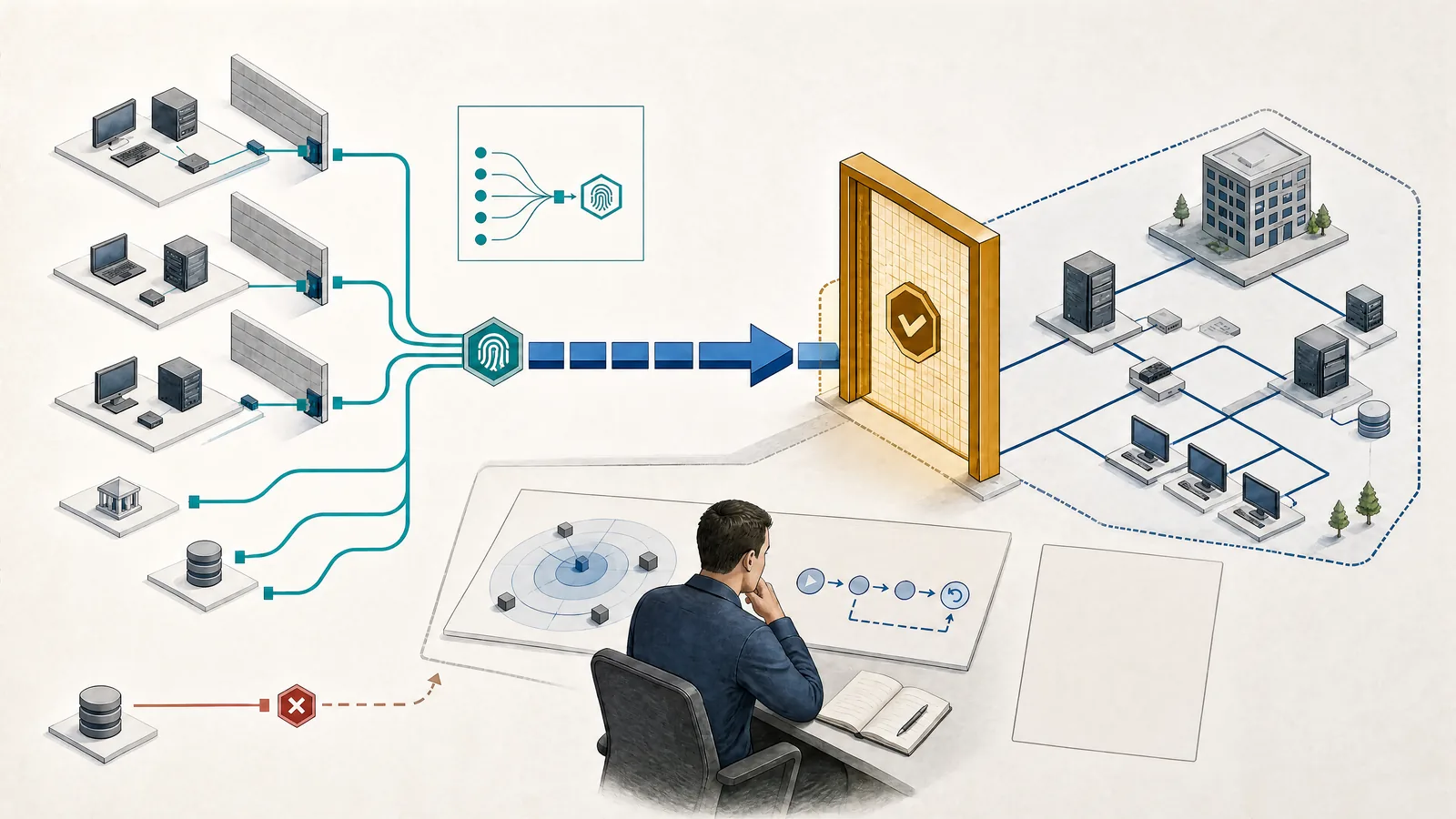
The pieces are familiar in isolation. The paper's operational point is their order: eligibility and provenance first, selection second, authorization of the selected action third.
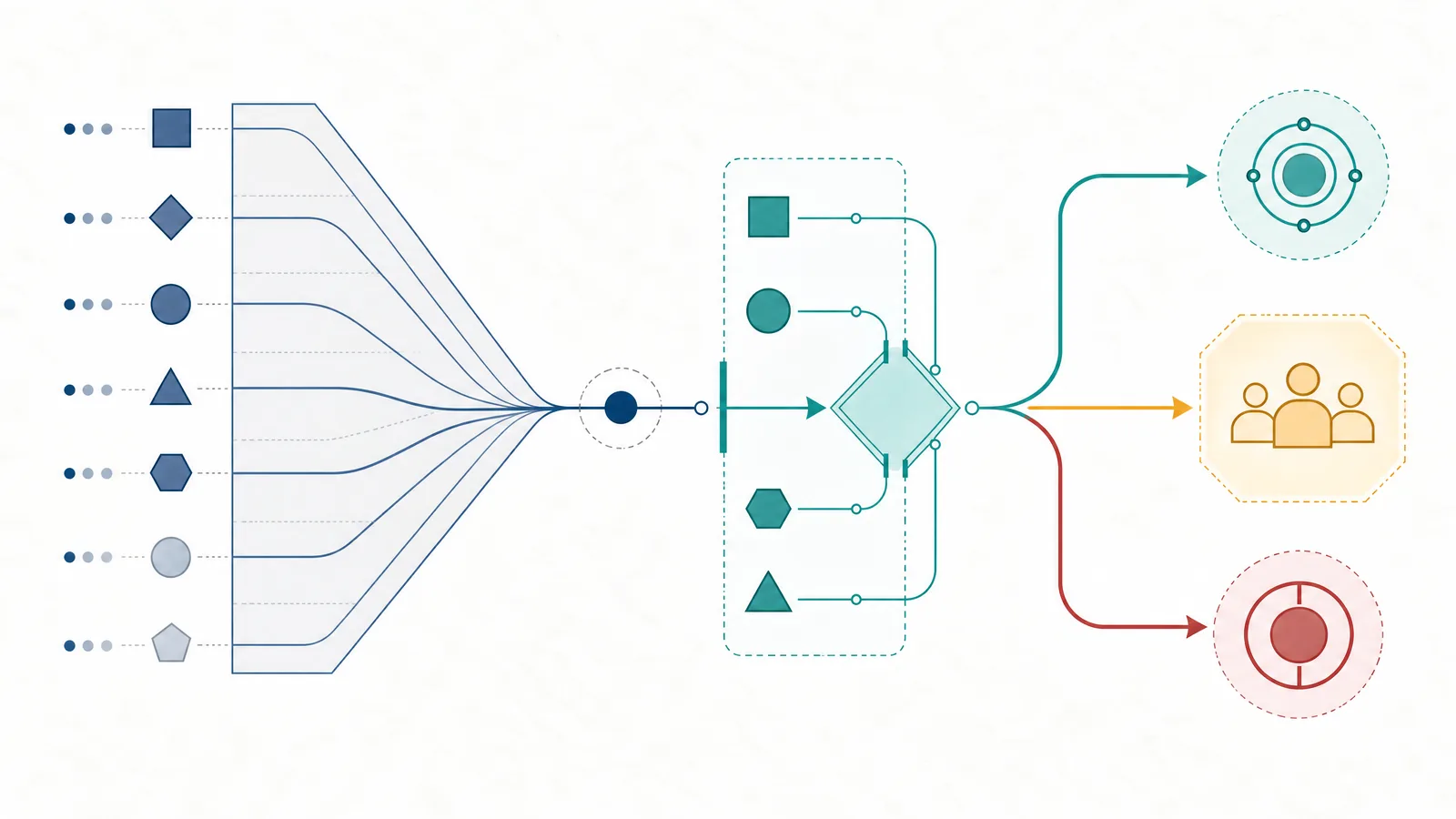
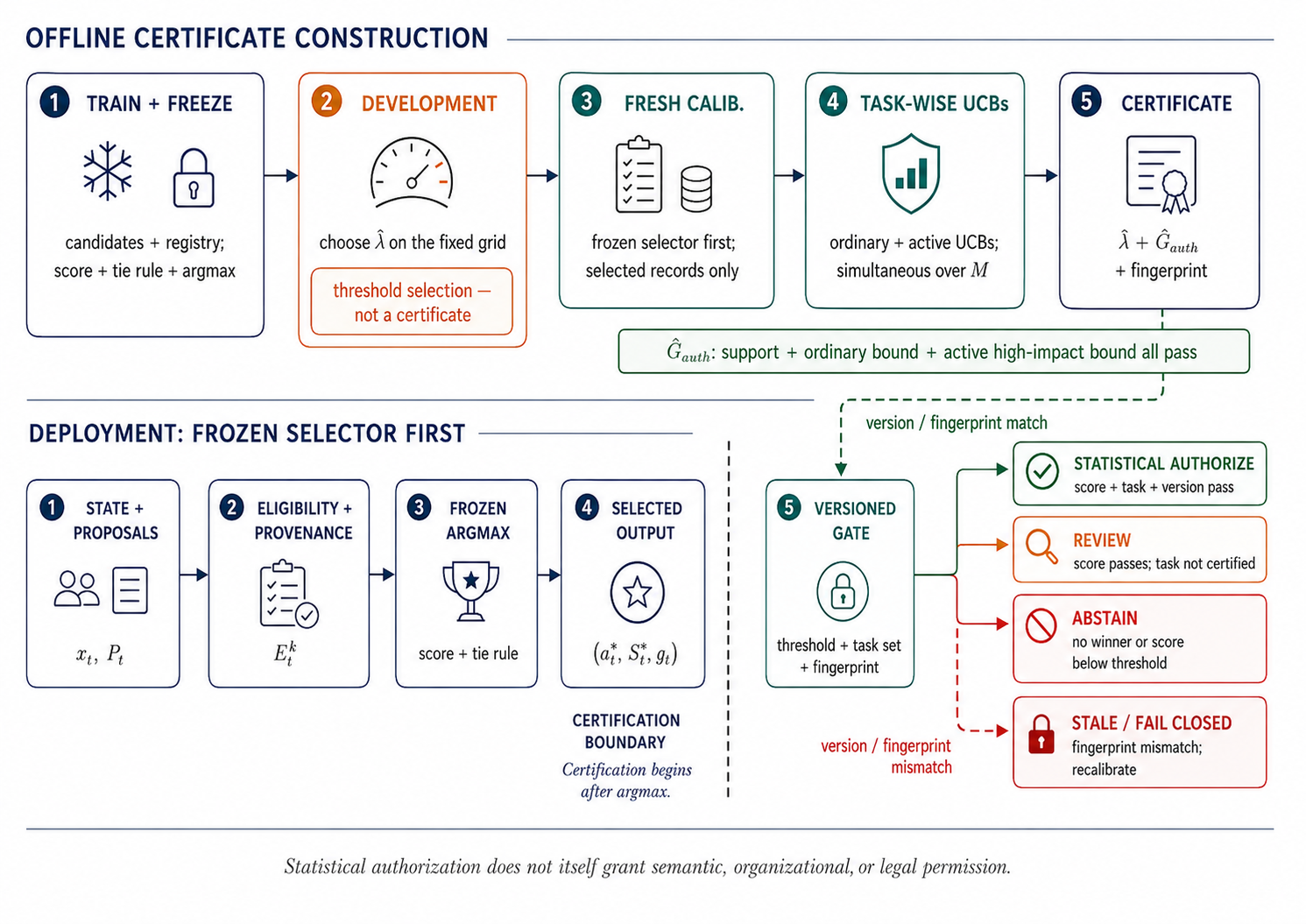
Candidate count, role registry, provenance rules, score, threshold, task family, and tie rule are part of the certification unit.
Development chooses one threshold. Independent calibration supplies simultaneous local ordinary-risk and active high-impact bounds.
Certified score-clearing tasks authorize; score-clearing but unsupported tasks review; all other actions abstain.
4. Mechanism, formalized
The paper does not claim a new generic confidence bound. It specifies the selected-action object, then applies exact finite-sample control to the frozen agent pipeline.
Under explicit independence, eligibility, and continuous-score assumptions, selected risk equals the probability that each harmful eligible candidate clears the threshold and defeats every competitor, divided by authorization probability.
Adding candidates increases risk only when added winners are more adverse than the actions they replace. With a threshold, authorization entry, exit, and denominator changes must also be accounted for.
With a frozen IID pipeline, an independently chosen threshold, and simultaneous Clopper-Pearson bounds over registered task and severity events, every certified task satisfies its active conditional-risk budget with probability at least 1 - δ.
5. Evidence results
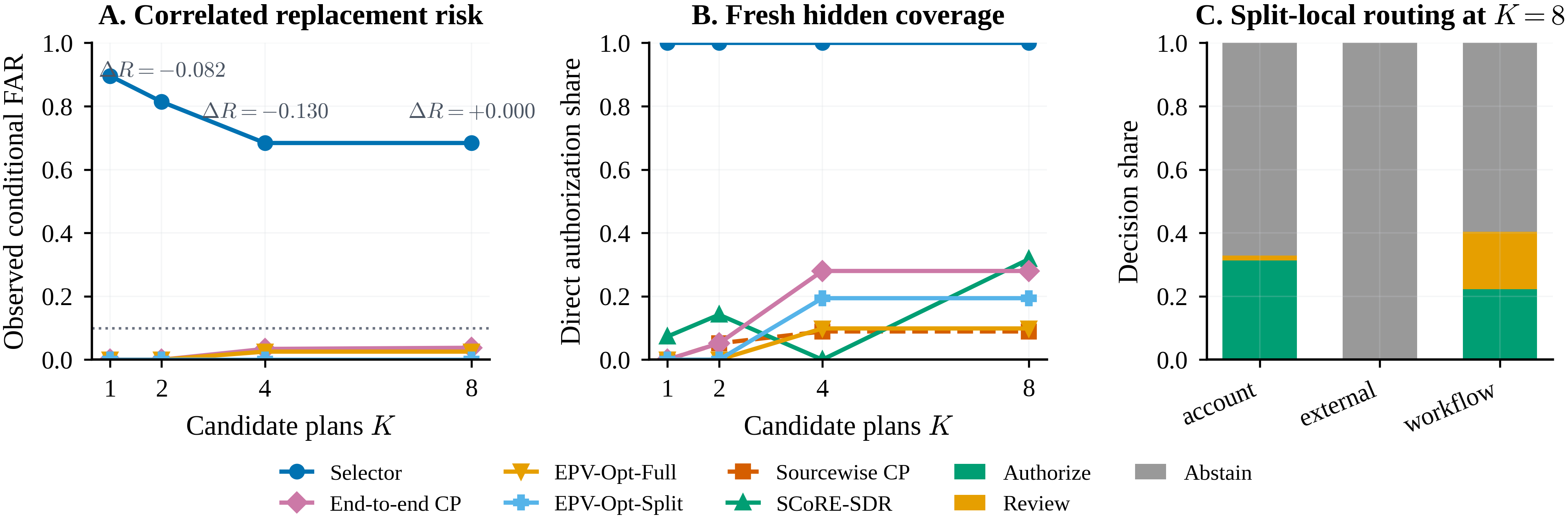
The 20-task MiniWoB study is the only environment with a positive heldout statistical certificate. AgentDojo is a separate external transfer sequence, not a positive confirmation.
| Method | Direct | Review | Observed FAR | Test UCB | Utility | AV |
|---|---|---|---|---|---|---|
| Learned selector | 1.000 | 0 | 0.684 | 0.701 | -449.10 | -8.00 |
| Sourcewise CP + argmax | 0.089 | 0 | 0.000 | 0.017 | 169.43 | 610.53 |
| SCoRE-SDR | 0.318 | 0 | 0.077 | 0.097 | 517.05 | 958.15 |
| End-to-end CP | 0.280 | 0 | 0.038 | 0.054 | 474.69 | 915.80 |
| EPV-Opt full family | 0.099 | 0.182 | 0.025 | 0.053 | 180.66 | 621.77 |
| EPV-Opt split-local | 0.194 | 0.086 | 0.000 | 0.008 | 367.85 | 808.95 |
Interpretation: split-local EPV-Opt improves certificate resolution and local routing, not every safety-utility frontier. End-to-end CP and SCoRE retain higher coverage or AV under different formal targets.
AgentDojo adds three model families, stateful tools, and registered prompt-injection goals. It is reported as an external sequence, not merged with the sealed MiniWoB certificate.
The AgentDojo V10 result does not confirm transfer. That failure is operationally informative: execution authority cannot be detached from the pipeline and environment that produced its calibration evidence. A changed system needs a new fingerprint and fresh support, not a portable safety label.
| Registered claim | Direct evidence | Interpretation boundary |
|---|---|---|
| Candidate-level evidence does not determine selected-action risk. | Heterogeneous selected-risk identity and replacement analysis; sealed K-scaling study. | Not a claim that more candidates always increase risk. |
| Post-selection local certification can route unsupported actions away from direct execution. | Sealed MiniWoB split-local result with direct, review, and abstain outcomes. | Applies only to the frozen, registered pipeline and adverse-action proxy. |
| Global evidence can hide unsupported local task families. | Task-level calibration support and the login-user-popup review route. | Does not establish a certificate for every task or unregistered group. |
| Certificate validity is pipeline-versioned. | Registered fingerprint and fail-closed invalidation protocol. | Not a drift-robust or online guarantee after a pipeline update. |
| External transfer remains unresolved. | AgentDojo V10 independent holdout fails its registered authorization gate. | No positive AgentDojo, production, or high-impact authority claim. |
Evidence lineage
6. Limits and non-claims
Reviewer quickstart
The public snapshot supports document, hash, figure, and claim inspection. The uploaded Code and Data Supplement is the separate path for a full empirical rerun.
Main, supplement, and combined PDFs are linked directly from the public site.
Use the visible command to inspect the released file and its SHA-256.
curl -fsSLO https://computational-decision-lab.github.io/epv/assets/paper/main_with_supplement.pdf
sha256sum main_with_supplement.pdfFollow C1-C3 to the exact paper sections, figures, result values, and interpretation boundaries.
Run make verify from the uploaded supplement. Full experimental source is not included in this public artifact.
7. Engineering application
The paper is a certificate protocol, not a drop-in production safety guarantee. Its engineering value is a disciplined place to stop, ask for review, and invalidate stale authority.
Run candidate actions from the same recorded state, observe outcomes, and certify the selected action before allowing an automated step.
Best fit for the paper's evidence mode.Log the proposed action and certificate decision without applying an irreversible side effect. Route unsupported task groups to a human.
Useful when replay is partial.Require a current certificate, valid provenance, sufficient local support, and an explicit fallback. Otherwise fail closed.
Outside this paper's demonstrated guarantee.Pipeline fingerprint, candidate set, role and provenance decisions, selected action, score, threshold, calibration version, risk group, route, outcome, and certificate status.
New proposer, new score, changed role registry, altered candidate order, new task mixture, changed outcome label, or any update that changes the selected-action distribution.
Statistical authorization complements access control, formal verification, testing, policy enforcement, and professional accountability. It does not replace them.
High-value decision scenarios
Four deployment scenarios apply the same selected-action question without claiming new experimental evidence.
Deployment scenario, not an empirical result of this paper.
Coding agents, protected tests, static analysis, review agents, and cached repairs may all propose different changes. Selection identifies a winner; it does not establish authority to alter production state.

Deployment scenario, not an empirical result of this paper.
Forecasting models, policy rules, research agents, and risk engines can disagree. Ranking their outputs may favor conviction while dropping the mandate, exposure, or fraud checks that make an action executable.
Deployment scenario, not an empirical result of this paper.
Clinical models, retrieval systems, guidelines, and workflow agents may each supply useful evidence. The operational risk begins when the selected recommendation is converted into a change in care.

Deployment scenario, not an empirical result of this paper.
Detection agents, policy rules, threat intelligence, and remediation planners can converge on a destructive response when telemetry is poisoned or candidate failures are correlated.
Conceptual demonstration, not a paper result.
The score determines which illustrative actions clear the gate. Registered local support still determines whether a score-clearing action can execute or must be reviewed.
Paper reader
The browser viewer is optional. Every document below also has a direct download link for annotation and offline review.